

Direct logit attribution: who wrote the answer?
The final logits are a linear readout of the residual stream, and the residual stream is just the sum of what every component wrote into it. So the logit difference between two answers decomposes exactly into one number per component: each attention head, each MLP, and the embedding.
That decomposition is direct logit attribution (DLA). It measures only the direct path from a component to the logits, ignoring effects routed through later components.
Key questions
- Which heads push the model toward the correct answer?
- Do any heads push against it?
- Does the decomposition actually add up?
Structure
- Set up
- Attribute the logit difference
- Check that it adds up
- Plot the contributions
- Select the top components
- Save
Model and data. GPT-2 small in float32. It is small enough that bfloat16 rounding visibly degrades its predictions, so the notebooks load it explicitly in float32. Eight indirect-object prompt pairs from murano.tasks.ioi.
Requirements. pip install murano-interp[plot]
1. Set up
Section titled “1. Set up”import torch
from murano import MuranoModel, Pipeline, keysfrom murano.steps import LoadPrompts, LogitAttribution, Plot, Save, SelectComponents
OUTPUT_DIR = "murano_outputs/logit_attribution"
# GPT-2 is small enough that bfloat16 rounding degrades its predictions.model = MuranoModel("gpt2", dtype=torch.float32)print(f"{model.model_id}: {model.n_layers} layers, {model.n_heads} heads")gpt2: 12 layers, 12 headsThis notebook uses the indirect-object-identification task from
murano.tasks. Each clean prompt names two people and then has the subject
give a drink, so the next token should be the other name, the indirect object.
The corrupt prompt swaps who gives, which flips the answer.
clean : When Mary and John went to the store, John gave a drink to ___ -> " Mary"corrupt: When Mary and John went to the store, Mary gave a drink to ___ -> " John"The metric throughout is the logit difference: the correct name’s logit minus the incorrect name’s. Positive means the model prefers the right answer.
from murano.tasks import ioi
task = ioi(n=8)print("clean  :", task.clean[0], "->", repr(task.correct[0]))print("corrupt:", task.corrupt[0], "->", repr(task.incorrect[0]))print(f"{len(task.clean)} prompt pairs")
clean : When Mary and John went to the store, John gave a drink to -> ' Mary'corrupt: When Mary and John went to the store, Mary gave a drink to -> ' John'8 prompt pairs2. Attribute the logit difference
Section titled “2. Attribute the logit difference”LogitAttribution takes the correct and incorrect answers and returns the signed
contribution of every component to logit(correct) - logit(incorrect).
Positive means the component pushes toward the right name. Negative means it actively pushes toward the wrong one.
results = Pipeline(    [        LoadPrompts(task.clean),        LogitAttribution(model, correct=task.correct, incorrect=task.incorrect),    ]).run()
attribution = results[keys.LOGIT_ATTRIBUTION]print("target :", attribution.target)print("total  :", f"{attribution.total:.4f}")
target : logit_difftotal : 2.39713. Check that it adds up
Section titled “3. Check that it adds up”If the decomposition is exact, the component contributions plus the embedding and
the catch-all other term must reconstruct the total logit difference.
completeness_error is that residual. It should be a rounding error.
The one approximation is the final layer norm, which is frozen at its observed scale so the readout stays linear.
print(f"total logit difference : {attribution.total:.6f}")print(f"completeness error     : {attribution.completeness_error:.2e}")
assert abs(attribution.completeness_error) < 1e-3, "decomposition does not close"print("\nthe decomposition is exact to float precision")
total logit difference : 2.397078completeness error : 4.51e-05
the decomposition is exact to float precision4. Plot the contributions
Section titled “4. Plot the contributions”Plot draws the largest contributors, signed. Blue bars push toward the correct answer, red bars push away.
Plot(output_dir=OUTPUT_DIR)(results);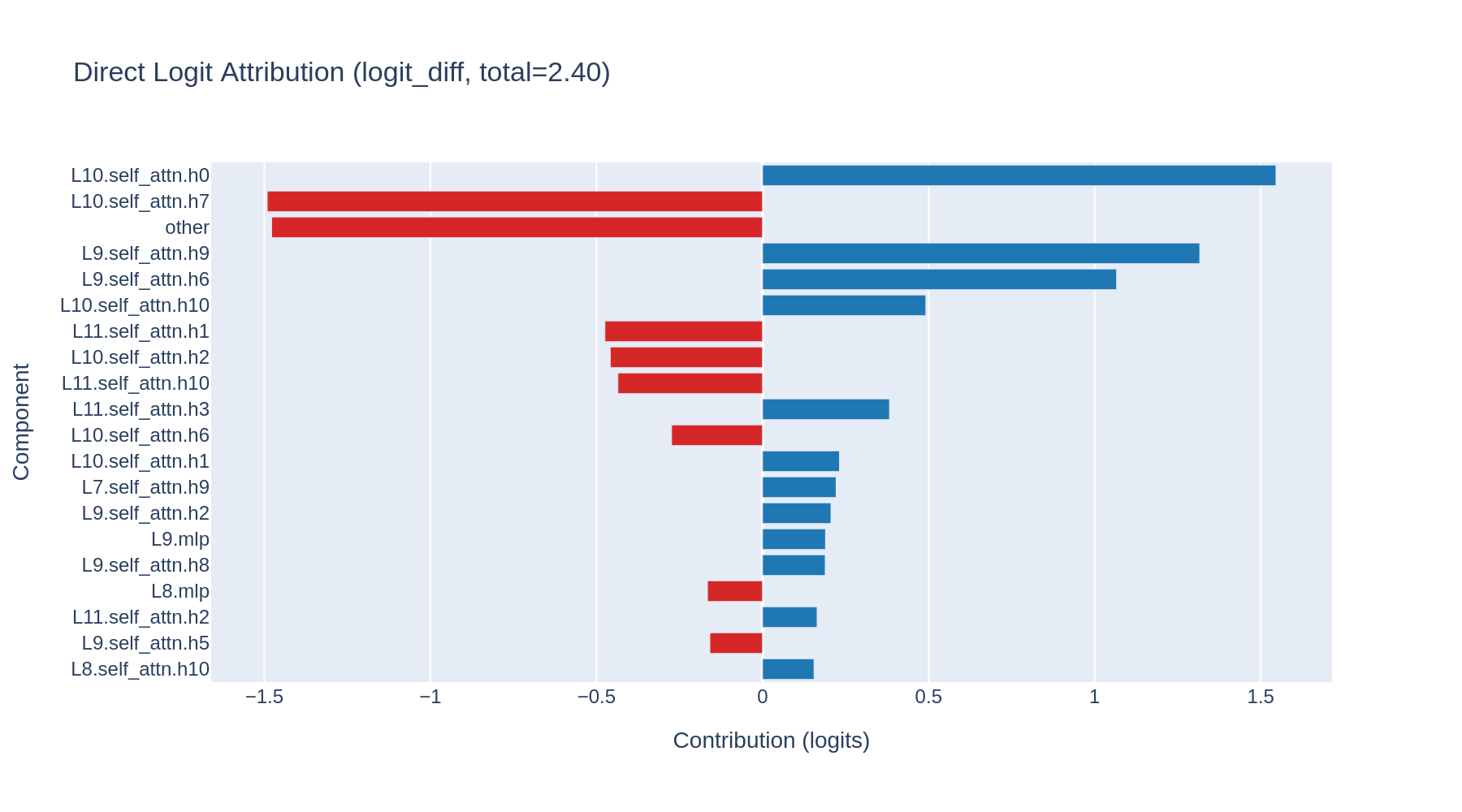
Some heads have clearly negative contributions. These are not noise. GPT-2 small contains negative name movers, heads that systematically suppress the correct name. They are a real and reproducible part of the circuit.
contributions = sorted(    attribution.contributions.items(), key=lambda kv: kv[1], reverse=True)
print("pushes TOWARD the correct name:")for node, value in contributions[:5]:    print(f"  {str(node):<24} {value:+.3f}")
print("\npushes AWAY from the correct name:")for node, value in contributions[-3:]:    print(f"  {str(node):<24} {value:+.3f}")
pushes TOWARD the correct name: L10.self_attn.h0 +1.546 L9.self_attn.h9 +1.316 L9.self_attn.h6 +1.066 L10.self_attn.h10 +0.492 L11.self_attn.h3 +0.382
pushes AWAY from the correct name: L10.self_attn.h2 -0.458 L11.self_attn.h1 -0.475 L10.self_attn.h7 -1.4915. Select the top components
Section titled “5. Select the top components”SelectComponents turns an attribution into a ComponentSelection, ranked by
absolute contribution so the negative heads survive the cut. Patch, PathPatch
and Ablate accept that selection by key, which is how attribution feeds into a
causal experiment.
results = SelectComponents(top_k=8, by="abs", modules="self_attn")(results)
selection = results[keys.SELECTION]print(f"selected {len(selection.nodes)} heads by |contribution|:\n")for node in selection.nodes:    print(f"  {str(node):<24} {attribution.contributions[node]:+.3f}")
selected 8 heads by |contribution|:
L10.self_attn.h0 +1.546 L10.self_attn.h7 -1.491 L9.self_attn.h9 +1.316 L9.self_attn.h6 +1.066 L10.self_attn.h10 +0.492 L11.self_attn.h1 -0.475 L10.self_attn.h2 -0.458 L11.self_attn.h10 -0.436The caveat that motivates the next notebook
Section titled “The caveat that motivates the next notebook”DLA sees only the direct path to the logits. A head that matters enormously by feeding another head, and never writes to the logits itself, scores near zero here. The indirect-object circuit has exactly such heads. Finding them needs an intervention, not a decomposition.
6. Save
Section titled “6. Save”run_dir = Save( output_dir="murano_outputs", run_name="logit_attribution", model_id=model.model_id)(results)[keys.OUTPUT_DIR]
print("saved to:", run_dir)saved to: murano_outputs/logit_attributionWhat next
Section titled “What next”activation_patching.ipynbmeasures each head’s total causal effect, including the indirect paths DLA cannot see.circuit_discovery.ipynbtraces how the heads found by patching reach the ones found here.